The theme for Women’s History Month 2026, designated by the National Women’s History Alliance, is “Leading the Change: Women Shaping a Sustainable Future”. This theme celebrates women who are building stronger communities, advancing equity, and developing systems for long-term environmental, economic, and social sustainability.
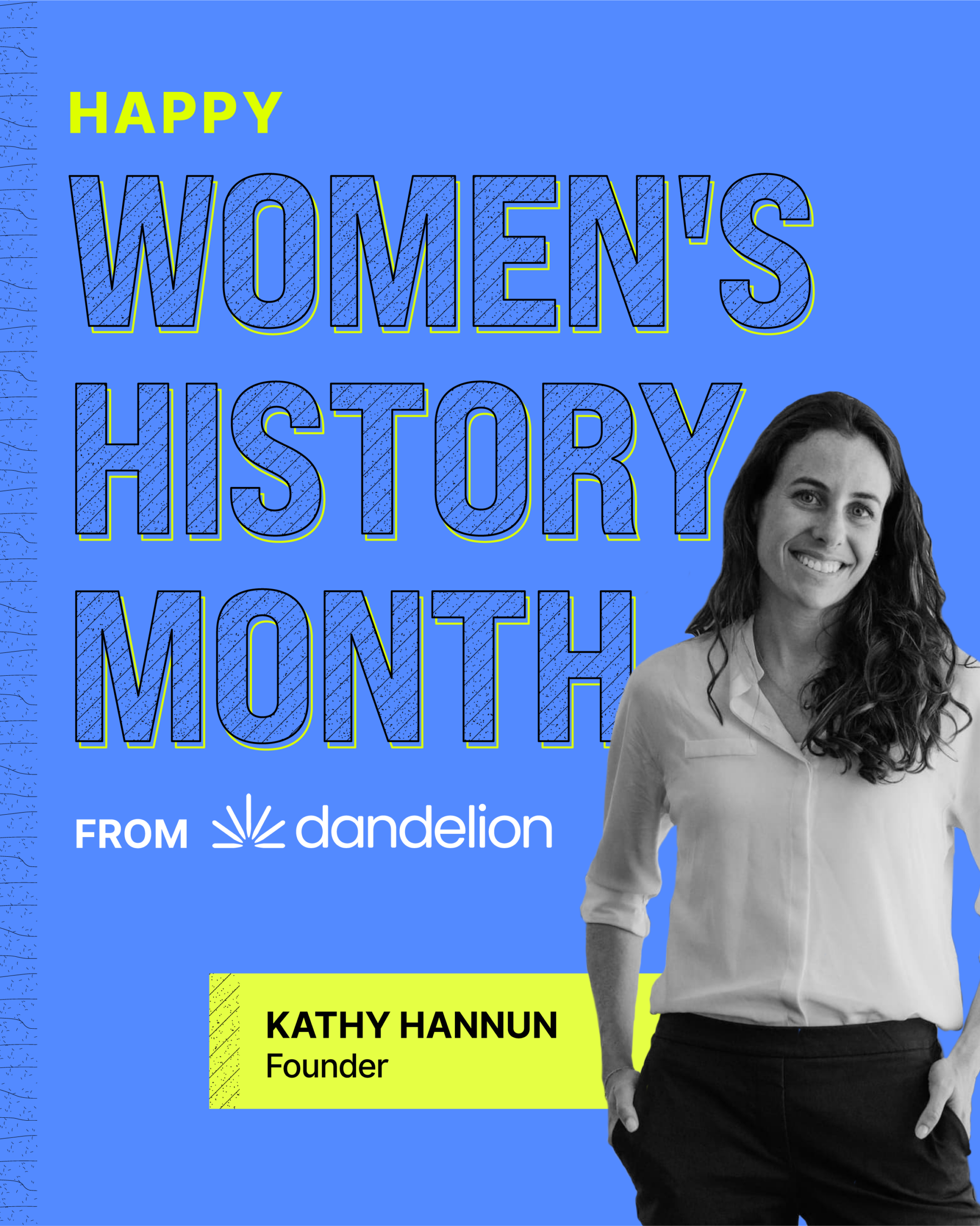
In celebration of our own company’s history for this month, we’re sharing a Q&A with Dandelion founder and CTO, Kathy Hannun. Kathy co-founded Dandelion in 2017 after incubating the company within Alphabet’s X Lab. She has been recognized as a CNBC Changemaker, a TED Fellow, one of Fast Company’s Most Creative People in Business, in MIT Technology Review’s “35 under 35,” and as the recipient of a C3E Award from the U.S. Department of Energy. She earned her B.S. in Civil Engineering and M.S. in Computer Science from Stanford University.
1. Q: When you co-founded Dandelion in 2017, what problem were you most urgently trying to solve?
Kathy: The urgent problem was the decarbonization of heating, which is often the “forgotten” giant of carbon emissions. Most people focus on cars or solar panels, but burning natural gas, fuel oil and propane for heat is incredibly carbon-intensive and expensive. Heating and cooling alone account for approximately half (51%) of all energy consumed in the average American home.
At Google X, we saw that geothermal was technically superior but commercially broken. It was too expensive, too “custom,” and lacked the standardization and cost efficiency that comes with scale. We wanted to turn a complex construction project into a streamlined consumer product to make fossil-fuel-free heating the obvious financial choice, not just the moral one.
2. Q: As Dandelion approaches its 10th year, what milestone makes you most optimistic that the “geothermal moment” has finally arrived?
Kathy: We are seeing a rapid alignment of policy and scale. Specifically, the Big Beautiful Bill provided a long-term runway with the 30%+ tax credit, which gave the industry the stability to invest in better hardware and made business models like the geothermal lease or geothermal-as-a-service possible in the US for the first time.
But beyond policy, it’s the grid reality. As the combination of AI, heat waves and cold snaps put more pressure on the electrical grid, utilities are realizing that geothermal is incredibly valuable: it’s the most efficient way to heat and cool, significantly reducing peak demand compared to air-source heat pumps. We aren’t just a “nice-to-have” anymore; we are a grid-stabilization tool.
3. Q: Dandelion has leaned into new construction… How does that strategic shift accelerate the original mission?
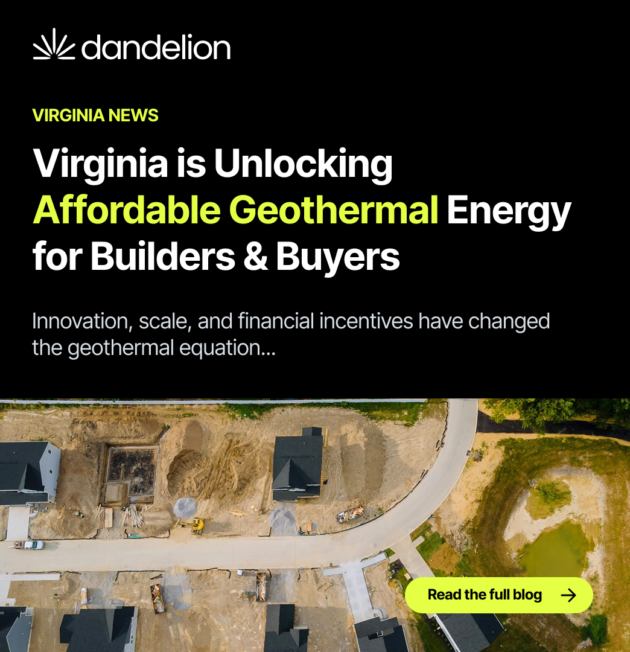
Kathy: The mission has always been about mass adoption. While retrofitting existing homes is vital, it’s a house-by-house battle. New construction allows us to go “neighborhood-wide.” By partnering with developers to install geothermal loops before the homes are even built, we eliminate the friction of individual sales and drilling logistics. It accelerates the mission by making geothermal the default standard for new homes rather than a premium upgrade.
The builders we’re working with have seen that customers prefer buying homes with geothermal installed – the geothermal makes homes easier to sell – and this dynamic is paving the way for geothermal to become the new standard.
4. Q: Who or what has influenced how you think about building a company with an environmental mission?
Kathy: The “X” (formerly Google X) mindset was foundational; the idea of “10x vs 10%.” Making any type of change is hard, so why not go after the impactful, ambitious problems that have the potential for significant impact? I’ve always sought a career devoted to honoring and preserving the natural world for future generations. My strategy has been to find the “less charismatic” problems in this vein (like home HVAC / drilling) and apply high-level engineering to them. The overlooked problems have a lot of potential if you can identify the ones with potential for impact, because there’s inherently a lot less competition and they’re less “picked over”.
I’ve also been influenced by the concept of pragmatic environmentalism. I believe that for an environmentally superior solution to win, it has to be truly better and cheaper than the incumbent. You can’t build a mission-driven company solely on the “goodwill” of customers; you have to build it on a superior value proposition. That is what draws me to geothermal: it’s a better product, a less expensive product, and it happens to be the most environmentally sound way to heat and cool.
5. Q: For someone early in their career in clean tech, what do you wish someone had told you?
Kathy: I wish someone had told me that “The hard stuff is where the value is.” In clean tech, there’s a temptation to stay in software because it’s faster and “cleaner” to scale. But the biggest levers for the planet are in the physical world, not just in bits. It’s related to the idea of chasing the “less charismatic” problems. Don’t be afraid of the “hard” tech: the drilling, the manufacturing, the logistics. I didn’t know anything about these things when I started, but I’ve learned. If you can solve a difficult physical constraint, you create a moat that is hard for anyone else to cross.
Thank you to Kathy for sharing her journey since 2017 and stay tuned for our upcoming 10-year anniversary in 2027!